Choking/priority between pulses and tracks

PolyPulse > Feature requests

Choke group between two tracks
(and/or by configuration of pulses)

the potential for this would be to reduce poly and for some frequency content control

So each track can be assigned to the same choke group and the 4 pulses of each track can be selected for that mute-groups within a priority window /setting

Simplest example

Trk:1: Pulse 1 = BD
Trk2: Pulse 1-2 = Baseline (mono)

By having these tracks share the same mute group with bass drum pulse having priority the bass and kick will never play at the same time …

this would mimic the affair of ducking bass frequencies of two tracks and save poly : bass & kick = 1voice always

Example 2

Two tracks
(both with set to: poly x2) they share the same mid frequency spectrum

So two mid-range sounds on track 3&4

if you set up the all the pulses of each track to choke one another:
the poly will alway remain 2 voices as they mute pone another one after the other

as pulses often hit on the same beat
a setting for Pulse Priority (1-4), window of pulses (1 gets highest priority) should be apllicable in some form

So Pulse 1 on track 3 has root note & has 1st prority (always plays) over the two mte groups for exsample

You can set priority to one track exclusively (always dominates) or playback order via priority of pulses

So tracks here are A vs B in choke group for refrenace

A >B (track 3 priority over track 4 … and its priority of trk pulses
B>A

x2
AA >B
BB>A

4x4
AA >BB
BB>AA

Ping pong
A<>B
B<>A

2x Pingpong
AA<>B
BB<>A

4xPingpong
AA<>BB
BB<>AA

Or chance / random
%<>%

this way both tracks (4 voices) can be set up to only use 2 voices (or 3 if you include bypass mode for a pulse (not effected by mute group!
and you may use this in creative way to get new rhythmic or fun sonic textures

Just thinking out loud, dont have one yet
thank you… :light_bulb: :face_blowing_a_kiss:

1 Like

Choking and/or priority in triggering between pulses (within one track) exists:

If pulse 1, 3, and 4 want to trigger at the same time, but the polyphony of that track is 2, only pulse 1 and 3 will trigger.

Therefore, if you want the snare never to play at the same time as the kick, you could have the kick be triggered by pulse 1 and the snare by pulse 2.

If some voices are already playing and need to be stopped because new notes are triggered they will be faded out based on which voice is the oldest. In the quad engine that works a bit different because it will also take into account which pulse (so which drum part) triggered the voice.

Hi there,

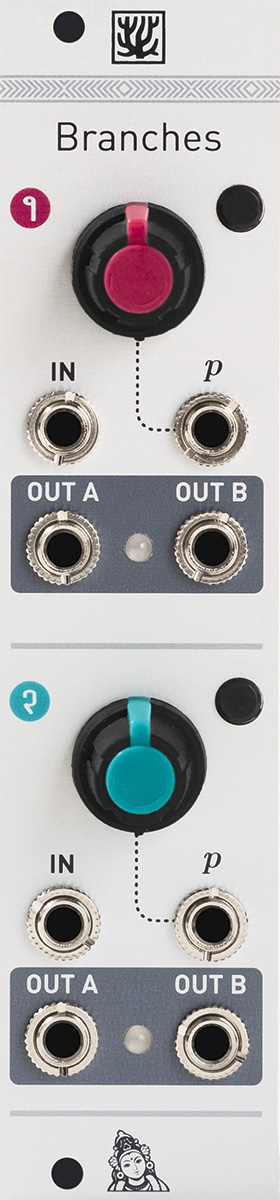
Apologies for the unclear explanation, I think the best way to illustrate is by referencing Mutable Instruments Branches, a utility module that combines inputs using probability (a Bernoulli-priciple).


So its similar zet applied to pulses between two tracks: (an 8-input structure) 4 for Track A VS 4 for Track B,
where incoming pulses are routed or muted across by rythmic ratios.

One feature that would complement this nicely is a
Track Copy
to New Track
function, to build melodic variations to a core melody :face_blowing_a_kiss:

Now In my first post, I mentioned a triggering ratio interplay between pulses, allowing control over triggering by set amounts rather than just %, it could be very powerful to define fixed rhythmic relationships. For example:

Pulse 2 (Track A) plays 5 times
Pulse 2 (Track B) plays 3 times

So effectively: Pulse2 → A x5 vs Pulse2 → B x3

This would allow users to create structured rhythmic ratios while still exploring generative behavior set bz the sequencer

I’m sure there is an elegant way this concept could be implemented on the PP :wink: … not that it needs another writers block solution :wink: … yet this also serves/ helps reduce polyphony usage, which can become quite expensive on Polypulse.

Thanks for your time and for the inspiring work!

The Mutable Instruments Branches Dual Bernoulli Gate Module takes a logic signal (trigger or gate) as an input, and routes it to either of its two outputs according to a random coin toss. The knob controls how fair the coin toss is – with the knob in minimal position, the first output always win, with the knob in maximal position the second output always wins – with random fun in-between. And obviously, this bias is CV-controllable!

1 Like